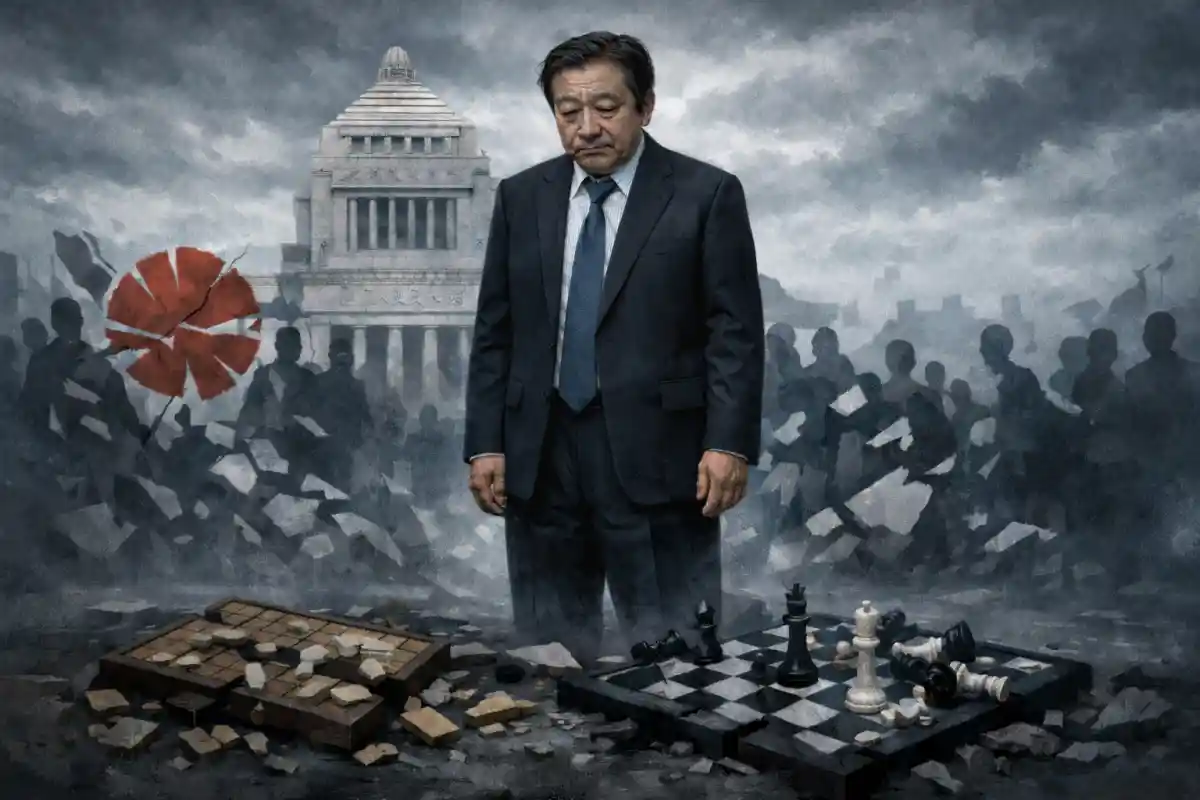
Banner for the article "The Great Sin of Yoshihiko Noda — The Collapse of Japan's Two-Party System"

The Great Sin of Yoshihiko Noda — The Collapse of Japan's Two-Party System


Author: MikeTurkey, in conversation with claude
Date: 11 Feb 2026

Other Languages

AI-translated articles, except English and Japanese version.

Summary


On February 8, 2026, a House of Representatives election was held in Japan.
Yoshihiko Noda, the leader of the opposition, responded to Prime Minister Takaichi's surprise dissolution by merging the Constitutional Democratic Party (CDP) and Komeito into a new party called the "Centrist Reform Alliance" just before the election.
This decision proved to be a fatal mistake.

When hit by a surprise attack, the standard response is to consolidate your forces and hold the line.
But Noda chose to restructure his organization instead.
Forced to launch a new party and prepare for an election simultaneously, the operation on the ground fell into chaos.

Voters knew nothing about the brand-new party.
Trust in a political party is built through long-term dialogue, and three weeks was nowhere near enough.
Information was confused, and voters could not tell fact from disinformation.

The merger with Komeito drove away CDP supporters.
Key policies on nuclear power and U.S. military bases were altered, and Komeito candidates were given priority on the proportional representation list.
Many supporters rejected the alliance with Soka Gakkai, an organization they had opposed for years.
Meanwhile, Komeito's own campaign workers were unable to adapt to the sudden new party, and their efforts were sluggish.
In short, both sides lost their supporters.

The LDP had plenty of vulnerabilities: forcing an election during record-breaking snowstorms and the ongoing Unification Church scandal, among others.
Yet Noda insisted on fighting a straightforward policy debate and failed to exploit his opponent's weaknesses.
Consumed by the need to explain the new party, he had no resources left to hammer home the LDP's problems.

This was the second time Noda led a party to a crushing defeat, following the 2012 election.
His behavior reflects a pro-wrestling mindset — a belief in the beauty of exchanging blows head-on, with no concept of defense.
This simple behavioral pattern is easily read by opponents.

The result: the new party won just 7 single-member district seats. The LDP won 249.
The opposition capable of challenging the LDP has been wiped out, and Japan's two-party system has collapsed.
This damage will not end with a single defeat. It will rigidify Japanese politics for years to come.

Noda is a sincere and good person. But sincerity and the ability to lead people to victory are two different things.

Introduction


This site does not normally cover politics.
However, a historic event has occurred, and I felt it must be documented. Please bear with me.
The subject is the House of Representatives election held on February 8, 2026.
What did Yoshihiko Noda, the leader of the opposition, do, and what was the result?
This article explains how his actions eliminated any opposition capable of challenging the ruling party, inflicting severe damage on Japanese politics.

I should explain why I chose the title "Great Sin" rather than "Strategic Failure."

"Great Sin" does not imply moral condemnation or personal attack.
It refers to a decision that produced political consequences that can never be reversed.

A strategic failure can be corrected. A second attempt is possible.
But in this case, that is no longer an option.
The institutional framework was destroyed.
Experienced personnel were lost.
Relationships of trust were severed.

As a result, the defeat was not a one-time event. A political structure predicated on future defeats has now been locked in.
The problem is not the defeat itself.
The problem is that the defeat eliminated future options.

Single-Member Districts — The Brutal Arena of Japan's House of Representatives


Japan's House of Representatives uses a parallel voting system: 289 seats are decided in single-member districts, and 176 seats through proportional representation blocks.

Because single-member districts account for the majority of seats, a party cannot take power without winning them.
For this reason, winning in single-member districts is considered paramount in Japanese politics.

However, since only one candidate can win per district, fierce battles over seats occur every election.
As a textbook explanation would note, candidates tend to be chosen based on personal reputation, and votes cast for losing candidates — known as wasted votes — are a persistent problem.

A unique feature of Japanese politics must be noted: the Liberal Democratic Party (LDP) has been the ruling party for roughly 70 years (with only about 5 years in opposition), and has built rock-solid electoral strongholds in single-member districts over decades.
As a result, around 20 top LDP figures have such strong footholds that they can win their districts even without personally campaigning there.

What do these 20 figures do during elections?
They serve as campaign reinforcements, traveling to support allied candidates in competitive districts.
As a result, the opposition is almost always fighting at a numerical disadvantage.

In strategy game terms, this resembles a classic mid-to-late-game move: concentrating surplus forces to eliminate the remaining enemy strongholds one by one.

The Sudden Merger of the CDP and Komeito


Yoshihiko Noda was the leader of the Constitutional Democratic Party (CDP), and the CDP was the only party in Japan capable of winning single-member districts against the LDP.
That is what it was.
From here, I will describe how he destroyed the CDP.

Around January 5–12, reports began to emerge that Prime Minister Takaichi might dissolve the House of Representatives.
To explain Japanese politics: this period is normally devoted to deliberating the national budget in the Diet.
Past prime ministers focused their energy on passing the budget by late March.
Yet Takaichi moved to dissolve the House. It was a surprise attack.

In response, the CDP and Komeito decided to merge and fight back.
This would prove to be a grave mistake.

Prime Minister Takaichi's Surprise Attack


Naturally, a surprise attack must not give the opponent time to prepare.
In Japanese politics, the ruling party controls the election schedule, so the election was set for the earliest possible date.
Below is the timeline.
You will see just how compressed the schedule was.

Around January 13–14, 2026 (media reports)

Reports emerged that Prime Minister Takaichi was considering dissolving the House of Representatives.
These were not official statements but media reports indicating she was "considering dissolution."

January 19, 2026

Prime Minister Sanae Takaichi officially announced the dissolution of the House of Representatives at a press conference.

January 23, 2026

The formal dissolution procedures for the House of Representatives were executed.
The official campaign start date was set for January 27, with the election day on February 8.

Around January 16–22, 2026

During this period, the CDP and Komeito merged to form the "Centrist Reform Alliance"
and began election preparations, according to media reports.

January 27, 2026

The official campaign period began (formal candidate registration and start of campaigning).

February 8, 2026

Election day for the House of Representatives.
The LDP and the ruling coalition led by Prime Minister Takaichi won by a landslide,
while the Centrist Reform Alliance suffered a devastating defeat.

Komeito's Organizational Power


Before discussing the new party's election strategy, the organizational nature of Komeito's campaigns must be explained.

Komeito's base is uniquely supported by Soka Gakkai, a Buddhist lay organization. This gives it a distinctive support structure unlike any other party.
Soka Gakkai commands an estimated 10,000 to 30,000 votes per single-member district (varying by region and mobilization rates).
As noted above, in single-member districts, those tens of thousands of votes can directly determine victory or defeat.

For this reason, the LDP and Komeito had formed a coalition and fought elections together since October 1999. However, due to policy disagreements, the coalition was dissolved in October 2025.
In other words, those bloc votes were up for grabs.

The New Party's (Centrist Reform Alliance) Election Strategy


As you may have already guessed, the new party's strategy was to add Soka Gakkai's organizational strength to win single-member districts.

But a new party needs a flagship policy.
The answer: "Permanent zero consumption tax on food."
Japan has been suffering from rising prices driven by a weak yen, while wage growth has been stagnant.
The strategy was to campaign on eliminating the consumption tax on food altogether.

The Great Sin of Noda — An Unprepared Organization That Could Not Mobilize


From here, I will explain how Noda's strategy fell apart.

When hit by a surprise attack, the standard response is to consolidate your organization and hold the line.
But this time, the organization was restructured in the middle of a surprise attack.
Forced to handle both organizational restructuring and election preparation simultaneously, the party was visibly paralyzed.
In my area, not a single campaign vehicle came by even once.

For those who want to see the extent of the chaos, a video by former Representative Kazuhiro Haraguchi illustrates it well.
Ref. https://www.youtube.com/shorts/goR2jPkLerg

The Great Sin of Noda — Promoting a Party with Zero Name Recognition in Just Three Weeks


Generally, the bond between a party and its voters is built on trust.
That takes a great deal of time.
This is why LDP members with long-established electoral strongholds rarely lose in single-member districts.

But because a new party was created just before the election, voters had no idea what it stood for.
You can read the platform on the website, you say?
Not at all — campaign promises are made to be broken. That much is universal.

Trust is cultivated through extended "dialogue" between candidates and voters.
I put "dialogue" in quotation marks to emphasize that it is different from "speeches."

A "speech" is one-way communication. "Dialogue" is two-way communication.
It is that two-way communication that builds trust.

But in just three weeks, there was no opportunity for this whatsoever.
All they could do was give speeches.

The Great Sin of Noda — Disinformation Running Rampant Online


Disinformation has always been part of politics.

Even before the internet, dubious documents were distributed from time to time.
But rural voters rarely encountered them.

Since the advent of the internet, disinformation is created and delivered to voters with ease.
Digital technology makes copying effortless, so disinformation is endlessly reproduced.
We might as well call our era the "age of disinformation."

During elections, disinformation proliferates without limit, and voters need to verify what is real and what is not.
However, with a new party created just three weeks earlier, information was in complete disarray.
An established party would have long-standing supporters capable of debunking disinformation.
But voters had no way to distinguish truth from falsehood.

The Great Sin of Noda — Major Policy Reversals That Unsettled Voters


The CDP's policies on nuclear power and U.S. military bases (Henoko, Okinawa) were as follows:
  • Nuclear Power Policy

    Aim for a society free of nuclear dependence (zero nuclear). Prioritize building a decentralized renewable energy society. No new construction, expansion, or restarts of nuclear plants.

  • U.S. Military Bases (Henoko)

    The party's official platform called for re-examining the Henoko relocation plan and revising it in a direction that gains the understanding of the Okinawan people.
    The party protested the government's forced construction and called for dialogue.
However, these critical policies were changed just before the election.
  • Nuclear Power Policy

    While the long-term goal remains a society free of nuclear dependence, the restart of nuclear plants would be permitted where safety is ensured, effective evacuation plans are in place, and local consent has been obtained.
  • U.S. Military Bases (Henoko)

    The Centrist Reform Alliance's position on Henoko was unresolved and had not been finalized.

These two policies were non-negotiable issues for core CDP supporters.

Regarding nuclear power, the so-called "safety myth" had been promoted for years in Japan, claiming that accidents would never occur.
But opponents of nuclear power had long argued that there is no safe location in Japan, one of the world's most earthquake-prone countries.
When that myth was shattered by the Fukushima nuclear disaster, the public reaction was fierce: How could anyone continue the same safety myth after what happened?

On military base policy, the previous position — to varying degrees — was to reduce the burden on local communities.
The abandonment of that stance became major news, particularly in Okinawa.

For core CDP supporters, these are issues that have persisted for decades and represent fundamental policy commitments.
As a result, many perceived this as a betrayal, and support is estimated to have weakened.

The Great Sin of Noda — CDP Supporters Who Loathe Soka Gakkai Abandon the Party


The CDP had long been a party that opposed the LDP-Komeito coalition.
As a result, many of its supporters harbored strong dislike for Soka Gakkai, Komeito's support organization.
Given that Soka Gakkai was the powerful organization that had propped up the LDP for years, the animosity was substantial.

Additionally, some Japanese people regard Soka Gakkai as a cult-like organization, finding its persistent door-to-door recruitment deeply unwelcome.
Many Japanese are simply fed up with the aggressive proselytizing.

The CDP is a constitutionalist party committed to upholding Japan's pacifist constitution.
The constitution guarantees the separation of religion and state, and many supporters feel strong aversion to religious organizations involving themselves in politics.

Therefore, any alliance with Komeito — backed by Soka Gakkai — required the utmost caution.
Under normal circumstances, it would have been necessary to engage in repeated dialogue with supporters over time to gain their understanding.

But during this election, virtually no such explanation was offered.
Furthermore, in his public videos, Noda was seen praising Daisaku Ikeda, the late leader of Soka Gakkai, and expressing agreement with its teachings.
CDP supporters who disliked Soka Gakkai likely felt considerable revulsion.

Those who wish to see the source can search for "I learned about centrism from Daisaku Ikeda Sensei" (「池田大作先生から中道を学んだ」).

The Great Sin of Noda — Prioritizing Komeito Candidates on the Proportional List Drives Supporters Away


To secure Komeito's support, 28 Komeito candidates were placed on the proportional representation list.
This was deeply unpopular.
Moreover, because these candidates were ranked near the top of the list, they were virtually guaranteed to win seats.

CDP supporters who disliked Soka Gakkai faced a dilemma: either vote for a different party, or — if they wanted their own candidates to win proportional seats — write the name of the new party on the ballot.

Some have also pointed out that because Komeito was favored at the top of the proportional list, the overall campaign effort may have been dampened.

The Great Sin of Noda — Soka Gakkai's Campaign Workers Were Sluggish Due to the Sudden Change


Originally, the CDP and Komeito shared similar political views.
But that was 25 years ago.
After years in coalition with the LDP, Soka Gakkai supporters had internalized LDP-aligned thinking. The new party's platform was likely difficult for them to accept.

Additionally, because their social networks consisted mostly of people close to the LDP, their outreach efforts gained little traction.

The Great Sin of Noda — Supporters and Representatives Had No Opportunity to Voice Dissent


Normally, when grievances arise, they are voiced and addressed through ongoing adjustments.
But because this was a brand-new party formed just before the election, supporters and voters went to the polls with their frustrations bottled up.

CDP representatives had experienced sudden pre-election disruptions three times in a row, preventing them from running a proper campaign each time.
They must have felt it was happening again.
However, voicing opposition just before the election would have deepened the organizational rift and made the situation even worse.
So they could not speak up.

The only representative who publicly expressed anger at being repeatedly forced into unwanted elections was Kazuhiro Haraguchi.
Many other representatives are believed to have shared the same frustration. The election was fought with discontent simmering beneath the surface.
It goes without saying that a proper campaign cannot be waged under such conditions.

Supporters, too, were carrying pent-up frustrations.
Even if they conveyed their grievances to the party leadership, there was no prospect of improvement during an active campaign.

For those who despised Soka Gakkai, this must have been a truly miserable election.
In the proportional representation vote, supporting their preferred candidates meant writing the name of the new party — thereby accepting that Komeito candidates they loathed would also win seats.
It was a painful choice.

Tip

What were the three pre-election disruptions?

The sudden snap election in November 2012.
The formation of the Party of Hope just before the snap election in September 2017.
And the turmoil surrounding this election.

The Great Sin of Noda — Failure to Exploit the LDP's Weaknesses


In this election, the LDP had significant vulnerabilities:
  1. Dissolving the Diet for an election when the national budget should have been the priority.

  2. Holding an election in the dead of winter, when Japan's Sea of Japan coast is hit by heavy snowfall that disrupts daily life.

    This winter was exceptionally severe, with snowfall exceeding 1 meter along the Sea of Japan coast.
    In Aomori Prefecture, the snowfall reached disaster levels, requiring Self-Defense Forces deployment.
    Campaigning and voting were severely impaired, raising serious questions about the fairness of the election.
Ref. https://www.youtube.com/watch?v=-Xo3SMidzAk
Ref. https://www.youtube.com/watch?v=RLdOkYWcjWo
  1. Some LDP candidates ran for office despite confirmed ties to the Unification Church — a cult-like organization — including contact, financial support, and campaign assistance.

Yet the opposition failed to exploit any of these weaknesses.
There are two likely reasons:
  1. Noda's personality

    He insists on fighting elections through straightforward policy debate, making it impossible for him to maximize the opponent's weaknesses.
    Meanwhile, the LDP was aggressively highlighting every weakness of the new party.
  2. Creating a new party before the election left no resources for attack

    This overlaps with the earlier point about organizational paralysis. Because a new party was created, the campaign was consumed by explaining it to voters and could not effectively communicate the LDP's problems.
If the new party had not been created and the election had been fought under the existing CDP banner, the criticism of holding an election during record-breaking snowstorms could have been driven home effectively.
Had these vulnerabilities been fully communicated to voters, this article might have been titled "The Great Sin of Sanae Takaichi" instead.

The Great Sin of Noda — A Second Crushing Defeat as Party Leader


In November 2012, Yoshihiko Noda was serving as Prime Minister under the Democratic Party of Japan (DPJ) government.
The central issue at the time was a consumption tax hike.
Officially, the increase was for "social security," but in reality, the funds were needed to cover the enormous costs of the Fukushima nuclear disaster.

However, the DPJ had campaigned on a promise of governing without tax increases. The Japanese public was already fed up with rising taxes.

The proposed tax hike triggered fierce internal divisions within the party.
Then, in November, Noda suddenly declared dissolution of the House during a party leaders' debate.
Most DPJ members were unprepared for an election. Voters rejected the tax hike, and the DPJ suffered a devastating defeat.

Many people were reminded of this when they witnessed the second crushing defeat.

The Great Sin of Noda — A Pro-Wrestling Mindset That Destroyed the Party


Yoshihiko Noda's hobby is watching professional wrestling.
Perhaps because he loves it so much, his behavior appears to be captive to the behavioral norms of pro wrestling,
making him, from an opponent's perspective, an extremely easy adversary to handle.

What I mean by "pro-wrestling mindset" is the following:
  1. Absolute adherence to rules and agreements

    He operates on the assumption that once a commitment is made, it will be honored. The notion that commitments might be broken or ignored is treated as unacceptable.

  2. Belief in the straightforward approach

    He believes that if you explain things directly, maintain consistency, and present your case to the audience (voters), support will follow.

  3. Willingness to sacrifice himself

    When cornered, he does not flee but steps to the front line. He treats absorbing defeat and criticism as a virtue.

  4. Unconscious assumption that the opponent plays by the same rules

    He assumes the opponent also follows the rules and shares the same unspoken understanding.

To keep this brief, I will be concise.

The essence of pro wrestling is that trading blows is valued more than playing defense.
Noda is the kind of person who cannot help but strike back when attacked.

If your opponent knows you will never play defense, attacking becomes very easy. That goes without saying.

Tip

Japanese pro wrestling is built on the "beauty of receiving" — the principle that absorbing your opponent's moves is honorable.
It carries elements of bushido, with a strong tendency toward fighting fair and square.
By contrast, pro wrestling in the West is entertainment-focused, emphasizing storylines and drama.

The Great Sin of Noda — Did Prime Minister Takaichi's Speeches Worsen the Pro-Wrestling Mindset?


Here is an excerpt from a message by Prime Minister Sanae Takaichi:
"A nation that refuses to take on challenges has no future. Politics that only plays defense cannot inspire hope.
The future is something you carve out with your own hands."
Ref. https://www.youtube.com/watch?v=lRAK8w9ysbM

This message was frequently heard in campaign commercials during the election.

Translated through the pro-wrestling mindset, it reads like this:
"There is no guarantee of winning. But do not run — fight head-on. If you cannot do that, you have no right to speak about the future."

How would Yoshihiko Noda react upon hearing this?
Even with no chance of winning, he would absolutely charge in head-on.
Why?
Because if the opponent is fighting fair and square, he believes he must do the same.

But in an election, you must develop a strategy to win.
By repeatedly broadcasting this message, the LDP likely confirmed that Noda would only fight head-on,
making the election campaign much easier to manage.

The Great Sin of Noda — Has His Thinking Already Been Laid Bare by AI?


Continuing from the previous section. This kind of personality analysis can now be easily performed by AI.
In other words, there is a strong possibility that Yoshihiko Noda's behavioral patterns have already been read with high accuracy by AI.
His behavior is quite simple, so the analysis would have been quite straightforward.

It is therefore entirely plausible that the LDP crafted the above messaging specifically to trigger a self-destructive response.

There is a possibility that many people have already analyzed Noda's behavioral patterns using AI.
If he continues in a leadership role, all of his actions will be predictable, and he will be treated as a sitting duck.

The Great Sin of Noda — A Devastating Defeat and the Collapse of Japan's Two-Party System


As a result, the new party won just 7 single-member district seats and 42 proportional representation seats.
The LDP won 249 single-member district seats and 67 proportional representation seats.

Looking at proportional representation alone, the two parties appear nearly evenly matched. But in single-member districts, the defeat was catastrophic.
As explained earlier, winning single-member districts is essential in Japan.
With these numbers, taking power is impossible.

Furthermore, because veteran leaders and experienced politicians tend to hold single-member district seats, their loss means that Japan's two-party system has effectively collapsed.

Recall the strategy game analogy from earlier.
In Japanese elections, much like in the mid-to-late game of a strategy game, the winning side can concentrate surplus forces to eliminate remaining enemy strongholds one by one.
This means the LDP will have an overwhelming advantage for a considerable period going forward.

Consequently, Japan's future opposition is likely to consist only of parties that complement the LDP rather than challenge it (genuine opposition forces will be unable to grow into a major party).
This policy rigidity is expected to contribute to Japan's stagnation.

Conclusion


I understand that Yoshihiko Noda is a sincere and good person.
But he is not suited to be a politician.
As I have described, his way of thinking cannot lead people to victory,
and it is too late to change now.

I can only hope that candidates and supporters do not continue to follow him.

Being a good person is genuine. But being good and being able to lead people to victory are separate things.
A sincere person is a wonderful and trustworthy person to know.
But as we have seen, a sincere person's actions are too easily read, making it impossible to win.

Note

The banner image is not a likeness of any specific individual. It is an illustration symbolically representing the state and structure of Japanese politics.
The names mentioned in the text identify individuals as subjects of political analysis.

License

2023-2026 Copyright Mike Turkey All rights reserved.
Scope: This license applies to all non-code text content on miketurkey.com.
- Unauthorized copying and republication of this document is prohibited.
- Direct linking to this URL is permitted.
- If cited, summarized, or transformed, this copyright notice must be retained.
Illustration: Generated by MikeTurkey using DALL-E 3 (ChatGPT)

Back to the English version