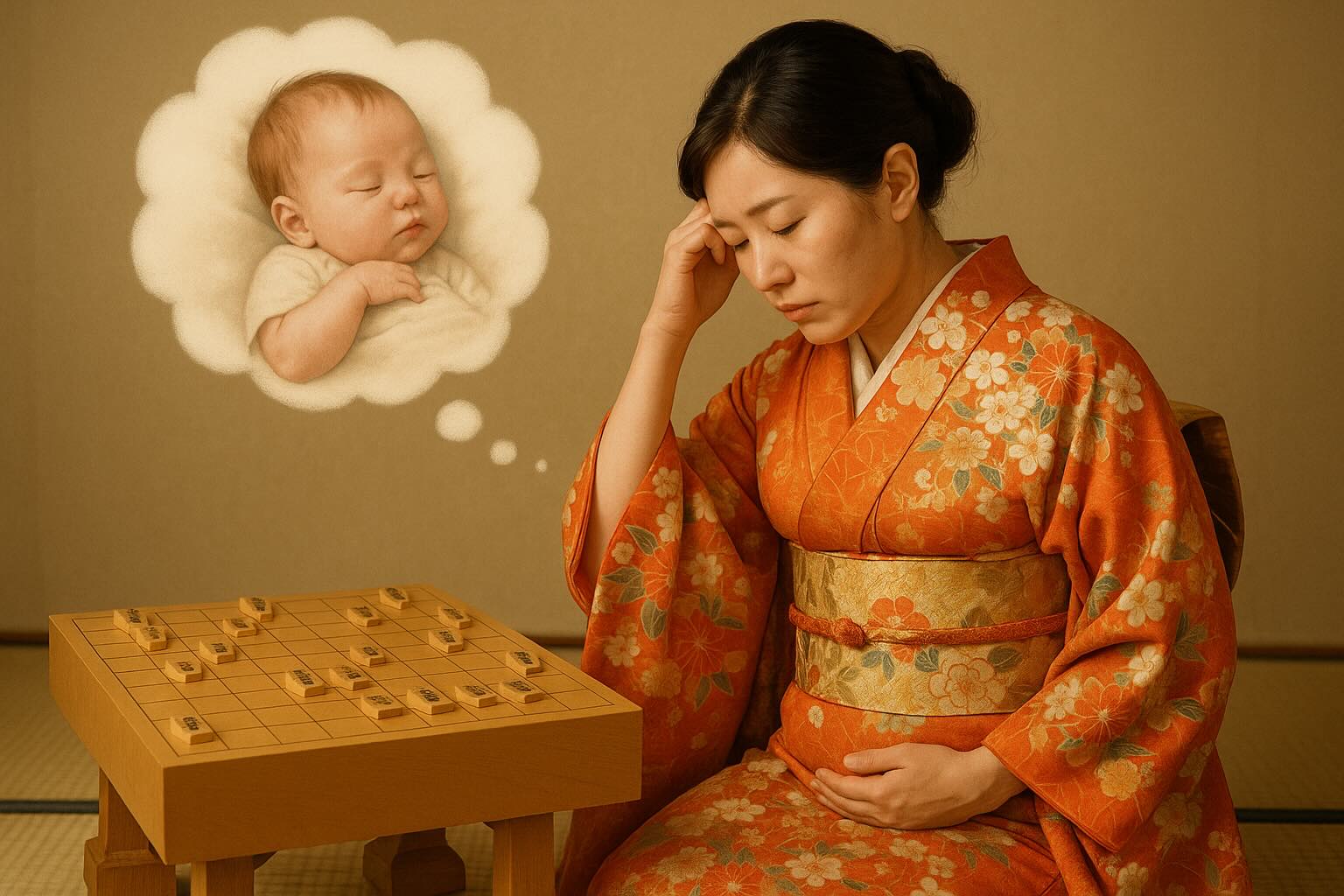
Career or Baby: One Japanese Woman Carries That Weight in a Traditional Society
Author: MikeTurkey, in conversation with claude
Date: 16 Dec 2025
Other Languages
AI-translated articles, except English and Japanese version.
A Question Raised by One Player
In December 2025, an event in Japan's shogi world drew considerable attention.
Kana Fukuma, who holds six women's titles and stands at the pinnacle of women's professional shogi, submitted a formal request to the Japan Shogi Association asking for a review of their regulations.
Shogi is a board game with over a thousand years of history in Japan. It shares origins with Western chess
and is sometimes called "Japanese chess."
Two players move pieces on a board, each trying to checkmate the opponent's king.
The major difference from chess is that captured pieces can be returned to the board as your own forces.
This rule means that forces don't diminish toward the endgame; instead, positions become increasingly complex.
Endgame battles are particularly intense, with players entering a state of extreme concentration.
In the tension where a single move can decide victory or defeat, some players cough from stress or flush red in the face.
It's an intellectual game played in silence, and in Japan, many fans are captivated by these strategic battles.
Under current competition rules, if an official title match falls within a certain period before or after an expected due date, the schedule is not changed,
and the match is held with another player instead.
As a result, even title holders may lose their titles without being given the opportunity to defend them.
If she wants a second child, no matter when she becomes pregnant, she could automatically lose some of her titles.
"I'm being forced to choose between pregnancy and my titles," she said.
This issue extends beyond the shogi world. Women around the world face the same question, even if it takes different forms.
The Player Called "The Lightning of Izumo"
Kana Fukuma is from Izumo City, Shimane Prefecture. She made her professional debut as a women's shogi player at just 12 years old, and her playing style is characterized by sharp endgame attacks,
earning her the nickname "The Lightning of Izumo."
Her aggressive style cuts through opponents' defenses all at once.
She has captivated many fans by pulling off brilliant comebacks even from seemingly losing positions.
Her career total of 67 titles is the all-time record for women's players.
She currently holds six of the eight women's titles, standing unquestionably at the top of women's professional shogi.
As a pioneer who has led women's shogi for many years and contributed to promoting the game,
this player who attacks more boldly than anyone on the board has encountered an unexpected wall in the life stage of pregnancy and childbirth.
Tip
Izumo is a place name in Japan.
It is home to Izumo Taisha, a very famous shrine that attracts many visitors.
The shrine is extremely ancient, and it's unclear exactly when it was built.
Some theories date it to around 720 AD.
Maternal Protection and Career Protection Are Separate Issues
What does it mean to "protect" a pregnant woman?
There is the concept of maternal protection.
Excessive stress and strain during pregnancy can negatively affect the health of both mother and fetus.
That's why rest periods are established before and after childbirth. This is medically sound consideration.
Shogi title matches carry extremely high mental strain, and concerns about subjecting pregnant women to this are understandable.
However, current regulations impose the disadvantage of a "forfeit loss" in the name of maternal protection. Taking time off and losing one's career should be separate matters.
If the true goal is to protect mothers, there should be room to consider other options.
In her request, Fukuma asked that participation be adjustable based on physical condition and doctor's advice, that schedule and venue changes be permitted, and that title holder status be guaranteed during leave.
If "protecting your health" results in "sacrificing your career,"
that's closer to exclusion than protection.
What Fukuma is asking for isn't to be forced to compete despite the strain, but rather a system that allows flexible responses based on the individual's wishes and physical condition, even during maternal protection periods. Can we separate taking time off from losing what you've earned? That's the question she's raising.
Because It's a Society of Women Only
If there's one source of hope here, it's that women's professional shogi is composed entirely of women.
Generally, organizations that are gender-integrated are considered fairer.
However, in this case, this unique organizational structure might work in their favor.
In a society where men and women compete on the same playing field, solving this problem becomes extremely difficult.
If accommodations for pregnancy and childbirth are granted only to female players, voices will inevitably arise saying "it's unfair that men don't receive equivalent consideration."
Where do you draw the line with illness or injury? What about caring for aging parents? Debates over fairness expand endlessly, and the conclusion often becomes "we make accommodations for no one."
But women's professional shogi is a society of women only. There's no direct competitive relationship with male players. Therefore, introducing "rules that accommodate women-specific circumstances" is less likely to devolve into the quagmire of fairness debates. There's room to attempt institutional reform.
The Japan Shogi Association announced that it is currently adjusting proposed revisions to the regulations in response to Fukuma's request. They stated they are considering a system that reflects the wishes of those involved.
Additionally, Kurashiki City, which hosts the title matches, has also requested the association review its regulations, calling it "a matter of individual dignity."
Precisely because it's the separate society of women's professional shogi, it could serve as a testing ground for progressive rules.
If it works here, it might offer insights for other fields as well.
A Universal Structure
This issue isn't unique to Japan.
In India, it's routine for companies to ask female job applicants about their plans for marriage and childbirth.
While firing someone for pregnancy is prohibited by law, such cases continue to occur in practice.
Some banks even have hiring guidelines that classify women more than 12 weeks pregnant as "temporarily ineligible."
This isn't a problem unique to capitalism.
In China, which espouses socialism, there is strong social criticism of young people who don't work due to difficult circumstances or who have opted out of competition.
e.g., "rat tribe," "lying flat"
Beyond ideology, human groups seem to have harsh views toward members who appear not to be contributing.
Anyone can get sick.
Everyone eventually grows old.
And without pregnant women, the next generation won't exist.
These are self-evident truths.
Yet why are we so harsh toward people who are temporarily unable to contribute?
What Our Cognitive Processes Create
In psychology, there's a concept called "processing fluency."
The human brain tends to prefer information that's easy to process and avoid complex information.
This tendency exists from birth and remains stable throughout life.
In organizations, responding to a pregnant employee is a complex challenge. Redistributing work, adjusting schedules, negotiating with stakeholders.
Many interests are entangled, and there are no easy solutions.
For shogi title matches, even more factors come into play: contracts with the newspaper companies that sponsor matches, securing venues, and more.
On the other hand, the fact that "someone is on leave" is immediately visible.
There's no need to analyze complex cause-and-effect relationships. For the brain, this is far easier to process.
What happens as a result?
Complex challenges get postponed, and attention turns to easily understood targets.
Rather than solving essential problems, the easiest option tends to be chosen.
The Truth Behind "Bad Things Come in Threes"
In Japan, there's a saying that "bad things happen one after another." But is this really a matter of luck?
In fact, it might be an issue of "processing fluency."
When the first problem occurs, the true cause is often complex and troublesome.
Avoiding that, we choose an easy, obvious response.
But since the root cause isn't resolved, problems erupt in different forms. We choose another obvious response.
This repetition might be the true nature of the "chain of misfortune."
The same pattern can be seen in how organizations handle pregnant employees.
It's an organizational problem where operations can't function when someone steps away.
But confronting that reality is difficult, so we settle for the conclusion that "things don't work when people take leave."
The structure remains unchanged, and when the next person needs time off, the same problem arises again.
Sound Rules Create Sound Competition
In the world of competition, rigor is natural. It's through unforgiving competition that true champions emerge.
However, rigor and irrationality are not the same thing.
In shogi matches, players fight with everything they have.
In the endgame, when check is called, the tension is tremendous—heart rates spike, and sometimes hands tremble. There's no room for mercy or accommodation in that moment.
That's healthy rigor.
However, losing the opportunity to compete simply because of pregnancy is a matter on a different dimension from the competition itself.
That's not "losing"—it's "never having the chance to fight." That can't be called meritocracy.
Irrational rules may appear to keep organizations running in the short term, but in the long term, they exclude talent.
If people realize "you can't have children in this world," talented individuals will choose different paths from the start.
The talent pool shrinks, the quality of competition declines, and society as a whole becomes weaker.
Sound rules create an environment where talented people can perform at their maximum potential.
Only with that foundation can true competition exist, wouldn't you say?
The Reality of Management Challenges
That said, this isn't a simple problem.
Organizations face real constraints.
Contracts, schedules, fairness with other members, the impact of setting precedents. It's easy to discuss ideals, but implementing them on the ground is difficult.
However, I'd like to pose this question: Who is bearing that difficulty?
Currently, the pregnant individual bears almost all of the burden.
Career interruption, lost opportunities, disadvantages upon returning. Can this be called a fair distribution of difficulty?
Which is more sustainable: sharing the burden little by little across the entire organization, or pushing everything onto one person?
License
2023-2026 Copyright MikeTurkey All rights reserved.
Scope: This license applies to all non-code text content on miketurkey.com.
- Unauthorized copying and republication of this document is prohibited.
- Direct linking to this URL is permitted.
- If cited, summarized, or transformed, this copyright notice must be retained.
Banner illustration: Generated by MikeTurkey using DALL-E 3 (ChatGPT)