Anthropic's Amodei and the Eternal Afterglow
-- Can the Military Use of AI Be Stopped? --
Part 1: Einstein — The Day Technology Betrays
Author: MikeTurkey, in conversation with claude
Date: 09 Mar 2026
Other Languages
AI-translated articles, except English and Japanese version.
Introduction: 1922, the Keio University Auditorium
On November 19, 1922, a physicist took the stage at the Great Auditorium
of Keio University in Mita, Tokyo. Albert Einstein, age 43. Having just
arrived in Japan after a voyage of more than a month from Marseille,
he spoke:
"I have come to tell the people of Japan how simple the theory of
relativity really is."
From 1:30 in the afternoon he spoke for three hours on special relativity,
took a one-hour break, and then spoke for another two hours on general
relativity. Roughly five hours in all. A newspaper notice the day before
had read:
"Note — As Professor Einstein has requested, the lecture is expected
to run for an extended period. Please bring bread."
The Yomiuri Shimbun reported that the audience was entranced by
Einstein's "musical voice, like the ringing of a golden bell," and
listened quietly and intently to the very end.
Over the course of his 43-day stay in Japan, Einstein visited Tokyo,
Kyoto, Osaka, Sendai, Nikko, and Fukuoka. He attended Noh theater
and developed a fondness for tempura and kombu.
In a letter to his sons, he wrote:
"Of all the peoples I have met so far, I like the Japanese best.
They are quiet, modest, intelligent, with a feel for art,
considerate, not focused on outward appearances,
and with a sense of responsibility."
His diary entry of December 10, 1922, reads:
"Nowhere else have I met people with such pure hearts as here.
One must love and esteem this country."
At the same time, he left behind a warning:
"The Japanese admire Western intellectual achievements and dive
into science with success and great idealism. But I hope that
the art of living, the modesty and simplicity, the pure and quiet
heart that the Japanese originally possessed before encountering
the West — I hope they will preserve all of these things and
never forget them."
Twenty-three years later, a weapon built on this man's scientific
discoveries would be dropped on this country he loved.
Tip
Keio University
One of Japan's oldest modern institutions of higher education,
founded in 1858 by Yukichi Fukuzawa.
Regarded as one of the top private universities in Japan.
The Mita campus is located in Minato City, Tokyo. The Great Auditorium,
a historic landmark, was built in 1927; Einstein's 1922 lecture was
held in the earlier auditorium on the same campus.
Tip
"Please bring bread"
A phrase from a newspaper notice of the Taisho era (1912–1926).
"Please bring bread" meant "Please bring a light meal."
In Japan at the time, it was customary for audiences to bring packed
lunches to lengthy academic lectures.
This notice itself is widely known as an anecdote reflecting the
excitement surrounding Einstein's lectures and the culture of
Taisho-era Japan.
Tip
Yomiuri Shimbun
A Japanese national newspaper founded in 1874.
It has one of the largest circulations in the world and wields
significant influence on public opinion in Japan.
Tip
Nikko
Located in Tochigi Prefecture, about 150 km (93 miles) north of Tokyo.
The Toshogu shrine complex, dedicated to Tokugawa Ieyasu (founder of
the Edo shogunate, 1543–1616), is registered as a UNESCO World
Cultural Heritage Site.
A scenic area renowned for its lavish carvings and natural beauty.
Tip
Noh
A traditional Japanese performing art perfected in the Muromachi
period (14th century) by the father-and-son duo Kan'ami and Zeami.
A highly stylized form of dance-drama performed with masks (Noh
masks), registered as a UNESCO Intangible Cultural Heritage.
Characterized by its extreme restraint of movement and symbolic
expression, it has a history spanning more than 600 years.
Tip
Tempura
A Japanese dish of seafood and vegetables coated in a light batter
and deep-fried.
Kombu is an edible kelp that forms the foundation of dashi (a
cooking stock used to extract umami), and is a key ingredient
underpinning Japanese culinary culture.
Umami — the "fifth taste" — was discovered in 1908 by the Japanese
scientist Kikunae Ikeda, who isolated it from kombu. It is now an
internationally recognized taste term.
Section 1: The Birth of Pure Science — 1905, the Swiss Patent Office
In 1905, a 26-year-old examiner at a patent office in Bern, Switzerland,
published several groundbreaking papers that would change the history
of physics forever. In what would later be called the Annus Mirabilis —
the "Miracle Year" — Einstein offered revolutionary insights into the
nature of light, the existence of atoms, and the fundamental structure
of space and time.
Among them was a single equation: E=mc².
Energy (E) equals mass (m) multiplied by the speed of light squared (c²).
It was the crystallization of pure intellectual pursuit, describing a
fundamental law of the universe. It was one answer to a question
the patent examiner had been turning over in his mind since boyhood,
during lunch breaks and stolen moments between tasks: "What would the
world look like if I could ride alongside a beam of light?"
Einstein himself was not certain how significant this equation would
prove to be. Much less did he imagine that it would become the
theoretical foundation for a weapon.
That is the nature of science. It is born from pure intellectual
curiosity — the desire to discover the truths of the world.
Nothing more, nothing less.
Just as it was for Einstein in 1905.
Section 2: Another Pure Scientist — Amodei's Starting Point
Now, in 2026, another person is experiencing anguish of the same
structure as Einstein's.
Dario Amodei. Co-founder and CEO of the AI company Anthropic.
The AI model he developed, Claude, was reportedly used in a preemptive
strike against Iran by the U.S. and Israeli militaries on
February 28, 2026.
Like Einstein, Amodei's starting point was pure science.
Born in San Francisco in 1983, Amodei was raised by an
Italian-American father who worked as a leather craftsman and a
Jewish-American mother. From an early age, he was interested in
nothing but math and science. According to his sister Daniela,
at the age of three he declared a "counting day" and spent the
entire day counting.
When the dot-com boom swept through his high school years,
it didn't register with him at all. As he put it:
"I had no interest whatsoever in writing websites.
What I was interested in was discovering fundamental
scientific truths."
He moved from the California Institute of Technology (Caltech) to
Stanford University, where he earned a bachelor's degree in physics.
In 2000, he was also selected as a member of the U.S. Physics
Olympiad team.
He then entered the doctoral program at Princeton University,
where a life-changing event occurred. In 2006, his father Ricardo
passed away after a long battle with a rare disease.
Amodei shifted from theoretical physics to biophysics — to understand
his father's illness and to open a path toward treatment. What made
it all the more devastating was that four years after his father's
death, a breakthrough therapy was developed that transformed the
disease from 50% fatal to 95% curable.
A few more years, and his father might have been saved.
"When people say, 'Oh, this guy's a doomer, he just wants to slow
things down,' it really makes me angry. You heard what I just said:
my father died because a treatment that could have been available
a few years earlier wasn't there yet.
I understand the benefits of this technology."
During his postdoctoral research at Stanford University School of
Medicine, working on cancer cell detection, Amodei came to a
painful realization about the limits of human capability.
"The complexity of the problems underlying biology is beyond
human scale. It would take hundreds or thousands of researchers
to understand it all."
This recognition led him into the world of AI — Baidu, Google Brain,
and then OpenAI. In every case, his motivation was the same pure
impulse: "to accelerate the progress of science."
In 2021, Amodei co-founded Anthropic with his sister Daniela.
Their mission: to build "safe and beneficial AI."
Just as Einstein sought to understand the structure of the universe
through E=mc², Amodei sought to transcend the limits of human
knowledge through artificial intelligence.
Both started from purely scientific motives.
In the beginning, neither had "thought at all" about how their
creations might be used.
Tip
California Institute of Technology (Caltech)
A world-class science and engineering research university
located in Pasadena, California.
Despite its small student body of approximately 2,200, Caltech has
produced more than 40 Nobel Prize laureates.
It is also known for operating NASA's Jet Propulsion Laboratory (JPL).
Section 3: Technology Escapes Its Creator — Einstein's Case
August 2, 1939.
Hungarian-born physicist Leo Szilard visited Einstein, who was staying
in Cutchogue on Long Island, New York. Szilard explained the
possibility of a nuclear chain reaction.
Einstein's response:
"Daran habe ich gar nicht gedacht."
(I hadn't thought of that at all.)
The very man who had discovered E=mc² had "not thought at all" that
his equation could be applied to a weapon.
But in that moment, Einstein was confronting a profound conflict —
not only as a scientist, but as a Jew.
In 1933, when the Nazis seized power, the persecution of Einstein
began immediately. A Nazi organization published a magazine featuring
his photograph under the headline "Not yet hanged." A bounty was
placed on his head. His family's bank accounts were frozen and
their property ransacked.
Einstein left Germany for good and never returned.
Why was the world's greatest mind subjected to such persecution?
Was it not an option for the Nazis to bring Einstein to their side?
The answer was no. For two reasons.
First, Einstein was Jewish. In Nazi ideology, being Jewish was itself
grounds for exclusion that overrode any conceivable usefulness.
In April 1933, Adolf Hitler's first anti-Jewish law stripped all
"non-Aryan" scholars of their academic positions. Twenty-five percent
of Germany's physicists — including eleven past or future Nobel
laureates — lost their jobs.
For the Nazis, the very concept of the universality of science was
a fiction; "science, like every other human product, is racial and
conditioned by blood."
Nobel laureates Philipp Lenard and Johannes Stark, two German
physicists, branded Einstein's theory of relativity as "Jewish physics"
and led a movement called Deutsche Physik ("German Physics") or
"Aryan physics." Lenard called Einstein's theory "the great Jewish
fraud," but in reality, Lenard himself could not grasp advanced
mathematics and sought to gain power by attacking as "Jewish" any
theory he could not understand.
Second, Einstein was the antithesis of Nazi ideology in every respect.
He was a pacifist, an internationalist, an antiwar advocate, and a
believer in equality and humanitarianism. During World War I, he had
openly criticized Imperial Germany for starting the war. For the
"stab-in-the-back" myth (Dolchstoßlegende) that Germans held dear —
the belief that they would have won the war had it not been for the
betrayal of bankers, Bolsheviks, and Jews — Einstein was the very
embodiment of that "traitor."
By contrast, the Nazis took a different approach with Aryan physicists.
Werner Heisenberg, a founder of quantum mechanics, was not Jewish,
but because he praised Einstein's theory of relativity in his lectures,
he was attacked in a Nazi newspaper as a "White Jew."
Yet Heinrich Himmler recognized Heisenberg's usefulness and protected
him on the condition that "he may teach relativity theory, but must
not mention Einstein's name."
Conditional exploitation for Aryans. Unconditional exclusion for Jews.
That was the logic of the Nazis.
In November 1938, the Nazis destroyed Jewish shops, homes, hospitals,
and synagogues, killed approximately 100 people, and arrested some
30,000 Jewish men. This was the pogrom known as Kristallnacht — the
Night of Broken Glass.
By 1939, 300,000 Jewish refugees had fled Nazi-controlled territory.
By the end of the war, six million Jews had been murdered in
the Holocaust.
Szilard, along with Eugene Wigner and Edward Teller — who also helped
draft the letter — were all Hungarian-born émigré physicists.
Those who had fled Nazi persecution gathered together to prevent the
Nazis from developing nuclear weapons.
Einstein had been a lifelong pacifist. During World War I, he had
openly criticized the war and called for conscientious objection.
But the reality of the Nazis shook his convictions to their core.
He later said:
"I do not say that I am an absolute pacifist. I am a committed
pacifist. It is true that I oppose the use of force under any
circumstances — with one exception.
When confronted by an enemy whose sole purpose is the destruction
of life itself — my life and the life of my people."
The Nazis were precisely such an enemy, whose aim was the
destruction of the Jewish people as such. To uphold pacifism
would have meant acquiescing in the extermination of his own people.
Yet at the same time, Einstein understood what this letter would
bring about. In 1952, he contributed an essay titled "My Apology
to the Japanese People" to Kaizo — the very Japanese magazine that
had once invited him to Japan — in which he wrote:
"I was well aware of the terrible danger to all mankind if these
experiments should succeed."
And yet he signed.
"The thought that Germany might be successful with such experiments
compelled me to take this step. I had no other choice."
The existential crisis as a Jew. His convictions as a pacifist.
His understanding as a scientist of the weapon's destructive power.
Caught among these three conflicts, he acted against his own nature.
He signed a letter urging President Franklin D. Roosevelt to
develop the atomic bomb.
That letter became the genesis of the Manhattan Project.
But here lies a deep irony. Einstein himself was excluded from the
Manhattan Project. His pacifist convictions were cited as grounds for
denying him a security clearance. The scientist who had pulled the
trigger on the atomic age was deemed "too dangerous" to participate
in it.
August 6, 1945: Hiroshima. August 9: Nagasaki.
Einstein had known nothing of the plan to drop the bomb.
The project set in motion by his letter dropped two suns on
the people of the country he loved.
After the war, he wrote to a Japanese friend:
"I have always condemned the use of the atomic bomb against Japan,
but I could not do anything at all to prevent that fateful decision."
In 1947, Newsweek ran a cover story with the headline "The Man Who
Started It All." Einstein said:
"Had I known that the Germans would not succeed in developing an
atomic bomb, I would have done nothing."
In 1954, the year before his death, he confessed to his friend,
the chemist Linus Pauling:
"I made one great mistake in my life — when I signed the letter to
President Roosevelt recommending that atom bombs be made."
And on April 11, 1955, just one week before his death, he affixed
his final signature. The Russell-Einstein Manifesto, drafted with
philosopher Bertrand Russell, called for the abolition of nuclear
weapons and the renunciation of war. Among its eleven signatories
was Hideki Yukawa, the first Japanese Nobel laureate.
The Manifesto reads:
"We appeal, as human beings, to human beings: Remember your
humanity, and forget the rest. If you can do so, the way lies
open to a new Paradise; if you cannot, there lies before you
the risk of universal death."
The paper of 1905. The letter of 1939. The manifesto of 1955.
The first signature was in pursuit of pure science; the most
regretted signature was complicity in weapons development;
the final signature called for the abolition of those very weapons.
Three signatures encapsulate, in one physicist's lifetime, the
anguish of "technology advancing in directions never intended."
Tip
Cutchogue
A small village on the North Fork of Long Island, New York.
A rural area surrounded by vineyards; in 1939, Einstein was
staying at a friend's vacation home there.
Tip
Hideki Yukawa (1907–1981)
The first Japanese Nobel Prize laureate (1949, Physics).
He theoretically predicted the existence of mesons as mediators
of the nuclear force.
In his later years, he devoted himself to the abolition of nuclear
weapons and the peace movement, and was one of the eleven scientists
who signed the Russell-Einstein Manifesto (1955).
His story is told in detail in Part 2 of this essay.
Section 4: Technology Escapes Its Creator — Amodei's Case
In June 2024, Anthropic signed a contract with the U.S. Department
of Defense worth up to $200 million. Through the defense technology
firm Palantir Technologies, Claude became the first American AI model
to be deployed on the government's classified networks.
Amodei was not opposed to military use per se. In his essay
"Machines of Loving Grace," he advocated an "entente strategy" in
which a coalition of democratic nations would leverage AI to maintain
an advantage over adversarial states.
But he had a clear line.
"No domestic mass surveillance" and "no fully autonomous weapons."
For Einstein, the line was "getting the bomb before the Nazis";
use for any other purpose was never envisioned.
For Amodei, the line was "defending democracy";
unrestricted military use was unacceptable.
Both drew a boundary around their technology: "This far, and no further."
And in both cases, that boundary was crossed by state power.
In January 2026, it was reported that the U.S. military had used Claude
in an operation to capture Venezuelan President Nicolás Maduro.
Without Amodei's knowledge, his technology had been embedded in the
core of a military operation.
Einstein was excluded from the Manhattan Project and lost any means
of knowing where his letter was heading.
Amodei, too, had not been told how his technology was being used
on the battlefield.
The moment technology escapes its creator's hands is the same now
as it was eighty years ago. Without the creator's knowledge,
technology is absorbed into the will of the state.
On February 24, Secretary of Defense Pete Hegseth met with Amodei
and demanded the complete removal of all safety measures.
The deadline: 5:01 PM, Friday, February 27.
Here, recall the structure of Section 3.
The Nazis presented Einstein with a binary choice: submit or
be excluded. For Einstein — a Jew and a pacifist — "submission"
was never an option. He left Germany.
Eighty years later, the U.S. government presented Amodei with a
choice of the same structure.
Comply by removing the safety measures, or be excluded.
Amodei refused.
In his statement, he said:
"In good conscience, I cannot accept their demands."
Einstein allowed only one exception to his pacifism: "when confronted
by an enemy whose sole purpose is the destruction of life itself."
Amodei, with the word "conscience," declared an unequivocal refusal
to allow his technology to be used for unrestricted killing.
President Donald Trump immediately ordered a halt to the use of all
Anthropic products across every government agency.
Secretary of Defense Hegseth designated Anthropic as a "supply chain
risk to national security" — a measure normally applied only to
companies from adversarial nations.
In Einstein's era, the Nazis branded his physics as "Jewish physics"
and excluded him. In Amodei's era, the U.S. government branded his
company as a "supply chain risk" and excluded him.
Treating a scientist's conscience as "an enemy of the state."
The names differ, but the structure is the same.
And then, on February 28 — just hours after that order.
The U.S. and Israeli militaries carried out a preemptive strike
against Iran: Operation Epic Fury. The Wall Street Journal and
Axios reported that Claude was used in the operation for intelligence
analysis, target identification, and combat scenario simulation.
Hours after a ban was imposed, the banned technology was used
in the operation.
The letter Einstein signed led to the bombing of Japan —
a target he had never envisioned.
The technology Amodei refused was used in an attack on Iran
mere hours after his refusal.
In Einstein's case, six years separated the letter from Hiroshima.
In Amodei's case, only hours separated refusal from use.
The speed at which technology escapes its creator's hands has
accelerated dramatically over eighty years.
Einstein had time to regret.
Amodei did not even have that.
Tip
Palantir Technologies
An American defense technology and data analytics firm founded in
2003 by Peter Thiel (co-founder of PayPal) and others.
The company name derives from the "seeing stones" in J.R.R.
Tolkien's The Lord of the Rings.
Known for its contracts with intelligence and defense agencies
including the CIA, NSA, and U.S. military, Palantir provides
platforms for counterterrorism and battlefield intelligence analysis.
Tip
Nicolás Maduro (b. 1962)
President of Venezuela (2013–present).
Successor to Hugo Chávez.
His authoritarian governance, the resulting economic crisis, and
massive refugee outflows have drawn international criticism.
Relations with the United States have been strained for years.
Tip
Pete Hegseth (b. 1980)
A former television host on FOX News and a military veteran
(Army National Guard; served in Iraq and Afghanistan).
In January 2025, he was appointed Secretary of Defense in the
second Trump administration. His appointment was backed by his
military experience and media profile, though some critics pointed
to his lack of experience in defense administration.
Tip
"Supply chain risk" designation
A measure by the U.S. federal government to exclude companies deemed
a national security threat from government procurement.
Previously applied to Chinese companies such as Huawei and ZTE,
its application to a domestic American AI company is highly unusual.
Tip
The Wall Street Journal (WSJ)
A U.S. financial and business newspaper founded in 1889, and one
of the world's most influential news organizations.
Axios is a U.S. news outlet founded in 2017, specializing in
political and technology breaking news and analysis.
Section 5: A Single Book — "The Making of the Atomic Bomb"
And yet, there is a crucial difference between Einstein and Amodei.
Einstein regretted after the fact.
"I made one great mistake in my life," he said.
Amodei is trying to prevent it before it happens.
Behind that resolve is a single book.
A journalist visiting Anthropic's San Francisco headquarters noticed
a thick volume on the coffee table. An Oppenheimer sticker was affixed
to an employee's laptop. The book was Richard Rhodes's The Making of
the Atomic Bomb. Amodei has repeatedly recommended this 900-page opus.
This book is not a how-to manual for building a nuclear weapon.
Published in 1986, it won the Pulitzer Prize, the National Book Award,
and the National Book Critics Circle Award — an extraordinary triple
crown. What the book depicts is the process by which a pure scientific
discovery was transformed, beyond the scientists' own intentions, into
the most devastating weapon in human history — and the anguish of the
scientists caught in that transformation.
The first half of the book portrays the golden age of early
twentieth-century physics. Beginning with Marie Curie's discovery of
radioactivity, it follows the development of quantum mechanics by
Ernest Rutherford, Niels Bohr, and Werner Heisenberg. Scientists
driven by pure intellectual curiosity gradually became aware of the
staggering energy locked inside the atom.
It was a beautiful, exhilarating adventure of the mind.
In the second half, that adventure turns dark.
The fear that Nazi Germany might develop nuclear weapons first drove
the scientists forward, and the Manhattan Project was set in motion.
The technical struggles at Los Alamos Laboratory. And then, on
July 16, 1945, the Trinity test in the New Mexico desert — the moment
humanity first witnessed a nuclear explosion.
At the heart of this book is the moral anguish of the scientists.
J. Robert Oppenheimer, the director of Los Alamos, says in
the book:
"The deep things in science are not found because they are useful;
they are found because it was possible to find them."
These words encapsulate both the essence of science and the tragedy
of its fruits being turned into weapons. Scientists "discover" truths;
they do not "invent" weapons. But the truths they discover are
exploited regardless of the discoverer's intent.
Even Edward Teller, called the father of the hydrogen bomb,
was tormented.
"To deflect my attention from physics, a full-time job I loved,
and to devote my energy to the study of weapons was not an easy
thing to do."
Teller said that the decision cost him "considerable time"
of agonizing.
The book also quotes extensively from the testimony of Hiroshima
survivors. Charred bodies of the living, skin hanging like rags.
Rhodes forces the reader to confront the fact that utilitarian
arguments about the bigger picture are not about chess pieces — they
are about the lives of men, women, and children.
The book's conclusion is this:
As Bohr had predicted, the rush of nations to secure nuclear safety
paradoxically made each nation less secure and brought them closer
to the brink of annihilation. The moral lesson drawn from this atomic
"epic" is that science can lead to evil, and that its temptation is
nearly impossible to resist.
In 2023, this book exploded in popularity among AI researchers.
The Atlantic reported:
"A generation of A.I. researchers developing technology that could
remake — or ruin — the world is treating Richard Rhodes's book
like a Bible."
Why "a Bible"?
Because the structure the book depicts maps with uncanny precision
onto the reality AI researchers are living through right now.
Research born of pure scientific curiosity. Technological progress
at speeds exceeding all expectations. Pressure for military
application. The moral anguish of the scientists. And technology
that slips from the hands of its discoverers and transforms
into weapons.
The Making of the Atomic Bomb is not a story about the past.
For scientists in the age of AI, it is a "book of prophecy"
about the future.
Amodei keeps this book in his office not as decoration.
It is there so that he can continually ask: "Which chapter of
the story written in this book are we living through right now?"
The scientists of the Manhattan Project felt regret after the bomb
was dropped. Amodei, carrying the lessons he learned from this book,
is trying to draw a line before the bomb falls.
At the World Economic Forum in Davos in January 2026, Amodei
compared the export of AI chips to China to "selling nuclear weapons
to North Korea." This analogy could only come from someone who has
read The Making of the Atomic Bomb.
But the voice of someone trying to prevent a tragedy that has not
yet happened is always harder to understand than the voice of someone
mourning a tragedy that already has.
Einstein's remorse was understood by the world only after Hiroshima
and Nagasaki.
The Making of the Atomic Bomb found its readership only after the
terror of nuclear weapons became real.
When will Amodei's warnings be understood?
Tip
Pulitzer Prize
The highest honor in American journalism and literature.
The National Book Award and the National Book Critics Circle Award
are each major American literary prizes.
To win all three simultaneously in the nonfiction category is an
exceedingly rare distinction, attesting to the book's extraordinary
historical and literary value.
Tip
J. Robert Oppenheimer (1904–1967)
A theoretical physicist.
As scientific director of the Manhattan Project, he oversaw the
development of the atomic bomb and was known as the "father of
the atomic bomb."
After the war, he opposed the development of the hydrogen bomb and,
during the Red Scare, had his security clearance revoked.
In 2023, the film Oppenheimer, directed by Christopher Nolan,
won the Academy Award for Best Picture, bringing his life story
back into the global spotlight.
Tip
World Economic Forum Annual Meeting (Davos)
An annual gathering held every January in the city of Davos
in eastern Switzerland.
Heads of state, CEOs of major corporations, representatives of
international organizations, and intellectuals convene to discuss
the world's economic, political, and social issues.
Conclusion: To Japan
In 1922, Einstein spoke these words to the people of Japan:
"I hope that the modesty and simplicity, the pure and quiet heart
that the Japanese originally possessed before encountering the
West — I hope they will preserve all of these things and never
forget them."
Having experienced Hiroshima and Nagasaki, Japan should be the
country best able to understand the anguish of "pure science
being turned into a weapon."
In physics, there is a concept called the Cosmic Microwave
Background (CMB). The afterglow of the Big Bang, 13.8 billion years
ago, still quietly pervades every corner of the universe.
It has not vanished. It has merely become harder to see.
Einstein's anguish is the same. It has not vanished.
As a "background radiation" of the scientist's conscience, it
quietly pervades the age of AI even now.
Amodei keeps Richard Rhodes's The Making of the Atomic Bomb in
Anthropic's office because he is receiving that radiation.
And in Japan, too, there was a physicist who fought the same fight
as Einstein.
When Einstein visited Japan in 1922,
that person was still a fifteen-year-old boy.
His name was Hideki Yukawa.
His story will be told in Part 2.
Tip
Cosmic Microwave Background (CMB)
The afterglow of light released during the Big Bang (the birth
of the universe) approximately 13.8 billion years ago.
As the universe expanded, its wavelength was stretched into
microwaves, and it is still observed nearly uniformly from
every direction in the sky. It was discovered by chance in 1965
by Arno Penzias and Robert Wilson at Bell Labs (Nobel Prize in
Physics, 1978), and it decisively confirmed the Big Bang theory.
In this essay, it is used as a metaphor for the conscience of
scientists enduring across the ages.
(Continued in Part 2: "Hideki Yukawa — The Day Politics Tramples Science")
License
2023-2026 Copyright MikeTurkey All rights reserved.
Scope: This license applies to all non-code text content on miketurkey.com.
- Unauthorized copying and republication of this document is prohibited.
- Direct linking to this URL is permitted.
- If cited, summarized, or transformed, this copyright notice must be retained.
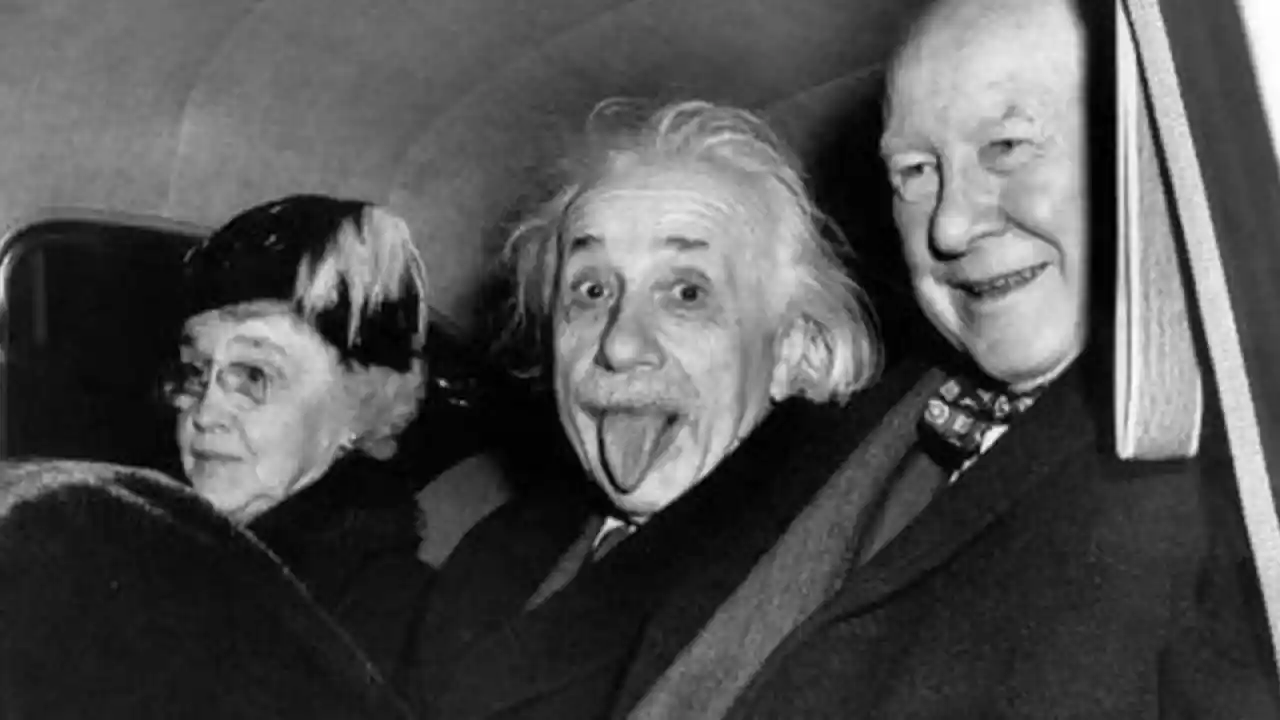
Photo: Arthur Sasse / UPI, 1951