Anthropic's Amodei and the Eternal Afterglow
-- Can the Military Use of AI Be Stopped? --
Part Two: Hideki Yukawa — The Day Politics Trampled Science
Author: MikeTurkey, in conversation with claude
Date: 09 Mar 2026
Other Languages
AI-translated articles, except English and Japanese version.
Introduction: A Fifteen-Year-Old Boy in Kyoto, 1922
In 1922, when Albert Einstein stood in the Keio University auditorium
and lectured on the theory of relativity for five hours, there was a
boy in Kyoto.
Hideki Yukawa, age fifteen.
Born to Takuji Ogawa, a geologist, Yukawa had been learning to recite
the Analects of Confucius and the Four Books and Five Classics under
his grandfather's tutelage since before he entered elementary school.
In his father's study, he encountered the Zhuangzi and became a
lifelong devotee. He was captivated by Western history books and
devoured every translated foreign novel he could find. At the same
time, he was passionate about geometry. He was a boy gifted more in
logical thinking than in powers of observation or memory.
Einstein's visit to Japan sparked an unprecedented science boom
across the country. Everywhere he went, the world-renowned physicist
was greeted like a Hollywood star, and his presence captured the
hearts of the younger generation. More than a few boys chose the
path of science, riding the wave of this boom.
Fifteen-year-old Hideki Yukawa was one of them.
He would go on to study theoretical physics at Kyoto Imperial
University, plunging into the world of quantum mechanics and
relativity that Einstein had opened up.
Tip
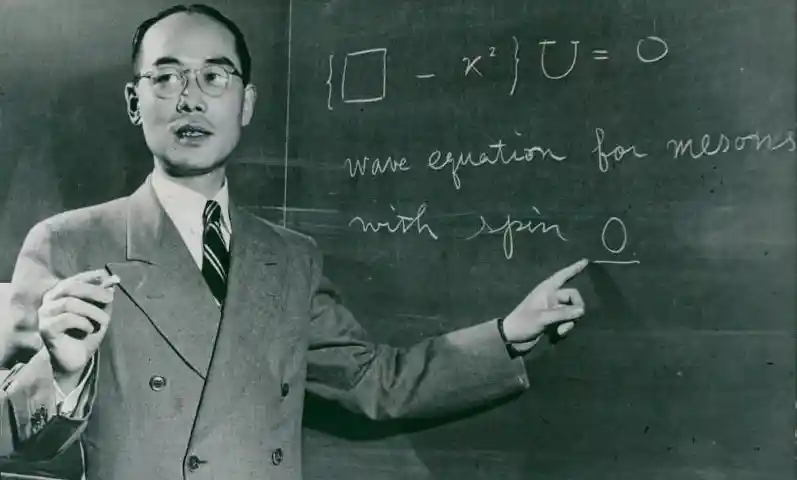
Hideki Yukawa (1907–1981)
A theoretical physicist from Kyoto Prefecture.
He theoretically predicted the existence of the meson, the
particle that mediates the force within atomic nuclei, and was
awarded the Nobel Prize in Physics in 1949. As the first Japanese
Nobel laureate, his achievement — coming just four years after
Japan's defeat in World War II — gave enormous hope to a nation
still under occupation.
In his later years, he devoted himself to the movement for
nuclear disarmament and peace.
Tip
Takuji Ogawa (1870–1941)
A geologist and geographer.
Professor at Kyoto Imperial University. He was Hideki Yukawa's
biological father. Yukawa took his mother's maiden name.
The Ogawa family was known for its academic lineage: Yukawa's
older brother Tamaki Ogawa became a scholar of Chinese literature,
and his younger brother Shigeki Ogawa became a metallurgist.
Tip
The Analects
A collection of sayings and ideas attributed to the Chinese
philosopher Confucius (c. 5th century BCE) and his disciples.
A foundational text of East Asian education and ethics, the
Analects was widely studied in Japan through sodoku — the practice
of reading classics aloud for memorization — especially during the
Edo period (1603–1868).
The Four Books and Five Classics are the core canon of
Confucian texts.
Tip
Zhuangzi
A foundational Daoist classic attributed to the Chinese thinker
Zhuang Zhou (c. 4th century BCE).
It expounds on the relativity of all things, effortless action
(wu wei), and the freedom of the spirit.
Yukawa was captivated by the Zhuangzi's philosophy throughout his
life and spoke of its influence on his own intuition in physics.
References to the Zhuangzi can be found in his book "Creativity
and Intuition."
Tip
Kyoto Imperial University
Founded in 1897 as Japan's second imperial university (now Kyoto
University).
It ranks alongside Tokyo Imperial University (now the University
of Tokyo) as one of Japan's most prestigious academic institutions.
Known for its tradition of academic freedom, it produced numerous
Nobel laureates, including Hideki Yukawa, Sin-Itiro Tomonaga,
Kenichi Fukui, and Susumu Tonegawa.
Section One: Meson Theory — Another Act of Pure Science
In 1935, twenty-eight-year-old Hideki Yukawa published a single
paper.
Inside the atomic nucleus, why do protons and neutrons stick
together? Protons carry positive charges, so they should repel each
other. Why, then, does the nucleus hold together without flying
apart?
Yukawa theoretically predicted that an unknown particle flies back
and forth between protons and neutrons, acting as a kind of "glue"
that binds the nucleus together. Because the mass of this particle
falls between that of the electron and the proton, it was named the
"meson."
This was an exercise in pure theoretical physics — a discovery born
from intellectual curiosity, an attempt to understand the structure
of the infinitesimally small world within the atomic nucleus.
Just as Einstein described the relationship between mass and energy
through E=mc², Yukawa described the essential nature of the nuclear
force through his meson theory. Both discoveries emerged from basic
research that had nothing to do with the military.
In 1947, the British physicist Cecil Powell discovered the pi-meson
in cosmic rays, experimentally confirming the validity of Yukawa's
theory.
In 1949, Hideki Yukawa became the first Japanese person to receive
the Nobel Prize in Physics.
For a Japan reduced to ashes by war, this award carried a special
significance. Just four years after defeat, it gave a nation that
had lost its confidence the hope that "we Japanese can do this,
too." Overnight, Yukawa became a national hero.
But this national hero would eventually face the reality that the
nuclear force he had spent his life studying had been harnessed for
both weapons and power plants — and that both would bring suffering
to people.
Tip
Meson
A subatomic particle that mediates the nuclear force binding
protons and neutrons within the atomic nucleus.
Yukawa theoretically predicted the existence of the meson in
1935, and in 1947, the British physicist Cecil Powell confirmed
the theory by discovering the pi-meson in cosmic ray observations.
Powell was awarded the Nobel Prize in Physics in 1950.
Section Two: War and the Anguish of a Scientist
There is a dark shadow in Yukawa's life that overlaps with
Einstein's.
During World War II, the Japanese government declared in 1943 that
the purpose of all scientific research would be unified under a
single goal: "the achievement of wartime objectives." Every
researcher was to be mobilized for military research.
Yukawa wanted to continue his basic research. He asked himself
again and again — should he be doing research for the war? Each
time, he returned to the same conclusion: it was important to
continue working in the field where he could contribute most, and
basic research was just as necessary as applied technology.
But he could not defy the government's orders. In the end, Yukawa
was assigned to participate in a Navy-commissioned research project
under the physicist Bunsaku Arakatsu.
This experience planted a deep fear in Yukawa — the fear of science
being conscripted by politics.
And then came August 6, 1945. Hiroshima. August 9, Nagasaki.
As a nuclear physicist, Yukawa understood the meaning of those
bombs more deeply than anyone. He understood that the force at the
heart of the atomic nucleus — the very force mediated by the meson
he had studied — lay at the foundation of a weapon capable of
annihilating an entire city.
In 1955, Yukawa added his name to the Russell-Einstein Manifesto,
which Einstein had signed just days before his death.
"We appeal, as human beings, to human beings: Remember your
humanity, and forget the rest."
Einstein's final signature, and Yukawa answered it.
Tip
Bunsaku Arakatsu (1890–1973)
A physicist at Kyoto Imperial University.
One of the pioneers of nuclear physics in Japan.
During World War II, he conducted nuclear research commissioned
by the Japanese Navy. Hideki Yukawa was assigned to his project,
though Japan's atomic bomb effort ultimately failed due to
resource shortages.
Japan's wartime nuclear research had two tracks: the Army's
"Ni-go Research" (RIKEN, led by Yoshio Nishina) and the Navy's
"F Research" (Kyoto Imperial University, led by Bunsaku
Arakatsu).
Section Three: The Battle at the Atomic Energy Commission — "Utmost Caution"
On January 1, 1956, the Japan Atomic Energy Commission was
established.
Its first chairman was Matsutaro Shoriki — the owner of the Yomiuri
Shimbun newspaper, the founder of Nippon Television, the man known
as the "Father of Japanese Professional Baseball," and the man who
would come to be called the "Father of Nuclear Power."
To understand what Yukawa was fighting against, one must understand
the true nature of Matsutaro Shoriki.
Shoriki's real ambition was never nuclear power.
According to the research of Professor Tetsuo Arima of Waseda
University, who deciphered declassified CIA documents from the U.S.
National Archives and Records Administration (NARA), Shoriki's true
goal was the construction of a nationwide "microwave communications
network."
Microwave technology had attracted attention during World War II
for its use in radar development and was capable of transmitting
voice, video, text, and still images at high volume and quality.
Shoriki aimed to build this network across the entire nation and
seize control of all communications infrastructure — radio,
television, fax, data broadcasting, police radio, train
communications, mobile communications, and long-distance telephone.
When Nippon Television launched in 1953, its official corporate
name was "Nippon Television Network Corporation" — the word
"Network" reflected this very ambition.
But this grand plan required funding. Shoriki needed a $10 million
loan from the United States, approval from the Japanese government,
and a license to enter the telecommunications business. However,
Prime Minister Shigeru Yoshida opposed the plan and moved to block
it by having the Nippon Telegraph and Telephone Public Corporation
(the predecessor of NTT) apply for a separate loan.
Shoriki arrived at a single conclusion: to realize his ambition,
he would have to become Prime Minister himself.
And Shoriki realized that nuclear power — then seen as a
technology of great promise — could serve as a powerful "political
card" to propel him to the premiership.
Achieve nuclear power (and claim the credit) → Become Prime
Minister → Realize the microwave network vision.
That was Shoriki's calculation. He had almost no scientific interest
in nuclear power itself. For him, nuclear power was nothing more
than a stairway to the office of Prime Minister.
Behind Shoriki, another force was at work.
A former police bureaucrat, Shoriki had been detained at Sugamo
Prison as a suspected Class-A war criminal after the war, but was
released without indictment. Professor Arima's research revealed
that after his release, Shoriki cooperated in covert operations for
the CIA. In classified CIA documents, Shoriki was given the
cryptonym "PODAM."
In 1954, the Japanese fishing vessel Lucky Dragon No. 5 was
irradiated by a U.S. hydrogen bomb test. A wave of anti-American,
anti-nuclear public sentiment swept across Japan. For the CIA, this
was "the greatest psychological warfare defeat since the end of
the Occupation."
The CIA needed a countermeasure. Shoriki was singled out for the
task.
Aligning with President Dwight D. Eisenhower's "Atoms for Peace"
policy, the CIA and Shoriki formed a partnership. The CIA wanted
to suppress anti-American sentiment in Japan and build
"pro-nuclear, pro-American public opinion" to counter the Soviet
Union. Shoriki wanted the premiership. Their interests aligned.
Shoriki used the Yomiuri Shimbun and Nippon Television to launch a
massive pro-nuclear propaganda campaign. "Atoms for Peace"
delegations were invited from the United States, and events were
held across the country. Disney's science propaganda film "Our
Friend the Atom" was broadcast as well.
Thus, without any scientific deliberation, the direction of
Japan's nuclear policy was set by political ambition and
geopolitical calculation.
In 1955, Shoriki was elected to the House of Representatives. The
following year, in 1956, he was appointed as the first chairman of
the Atomic Energy Commission.
On his first day in office, January 4, Shoriki announced his plan.
"Japan will build a nuclear power plant within five years."
At that moment, Hideki Yukawa understood what he would have to
fight against.
As one of the commissioners of the Atomic Energy Commission,
Yukawa nearly resigned on the very first day. He was persuaded to
stay by Kazuhisa Mori of the Japan Atomic Industrial Forum and
others, but the confrontation with Shoriki was already decisive
from the start.
For Yukawa, the nuclear force was the subject he had devoted his
entire life to studying. He was a scientist who understood the
nature of the force mediated by the meson more deeply than anyone.
And now, the technology that harnessed that force was about to be
introduced with no scientific review whatsoever — as a political
card for a man angling for the premiership, as an instrument of
CIA information warfare, with the attitude of "Full speed ahead."
As a scientist, there could be no greater insult.
Shoriki argued: "We'll import the technology from the United
States and have a nuclear power plant up and running in five
years." Yukawa countered: "Rushing into reactor construction while
skipping basic research will leave a legacy of disaster."
Yukawa wrote the following in the Atomic Energy Commission's
monthly report:
"Any decision regarding power agreements or the introduction of
power reactors will undoubtedly have profound and long-term
consequences for the future of nuclear energy development in our
country. Therefore, we must be cautious — cautious upon cautious."
Yukawa was not alone. His fellow scientists were also opposed to
the rush to build nuclear power plants. Physicist Shohei Miyahara,
a professor at Hokkaido University, called Shoriki's policy
"vulgar." Professor Koji Fushimi of Osaka University expressed his
concern this way:
"Terrifyingly lofty goals are set while ignoring the researchers,
and honest scientists end up falling off the stairway as they try
to climb it."
But Shoriki had no intention of listening.
When a government bureaucrat came to explain that the cost of
importing a nuclear reactor exceeded that of conventional thermal
power, Shoriki's response was:
"Shut up, you petty bureaucrat!"
Throughout the entire push, the words "safety first" never once
came from Shoriki. All there was, was "Full speed ahead."
Meanwhile, the Federation of Electric Power Companies of Japan
petitioned the Atomic Energy Commission, claiming that 450,000
kilowatts of nuclear power would be needed by 1965. The
justification was a projected future "power shortage."
Later verification showed this projection was wildly off the mark.
By 1965, thermal power generation had reached approximately 2.7
times the forecast, while nuclear power output was zero. There was
no need to depend on nuclear power yet. But at the time, these
figures were used to bolster Shoriki's "build a nuclear plant in
five years" agenda.
The scientists' calls for "caution" were systematically trampled
by the ambition of politicians, the interests of the business
world, and the strategy of the United States.
In December 1956, despite the scientists' concerns, the Atomic
Energy Commission decided to build a nuclear power plant by 1965.
In March 1957, Hideki Yukawa resigned from the Atomic Energy
Commission. He had served for just one year and three months. The
official reason was "a nervous gastrointestinal disorder." In
reality, it was a resignation in protest.
The warning of a Nobel Prize-winning physicist was crushed by the
ambition of a politician seeking the premiership, the CIA's
information warfare, and the interests of the electric power
industry.
Tip
Matsutaro Shoriki (1885–1969)
Owner of the Yomiuri Shimbun, founder of Nippon Television, and
member of the House of Representatives.
A former police bureaucrat, he was involved in maintaining public
order after the Great Kanto Earthquake (1923). After the war, he
was detained at Sugamo Prison as a suspected Class-A war criminal
but was released without indictment. As the first chairman of the
Japan Atomic Energy Commission, he pushed for the early adoption
of British reactors and was called the "Father of Nuclear Power."
He also contributed to the development of professional baseball in
Japan and is known as the "Father of Japanese Professional
Baseball."
Tip
Yomiuri Shimbun
A Japanese national newspaper founded in 1874.
It has one of the largest circulation figures in the world and
wields significant influence on public opinion in Japan.
Matsutaro Shoriki acquired its management rights in 1924 and
transformed it into a modern mass-market newspaper.
Tip
Nippon Television Network Corporation (NTV)
Launched in 1953 as Japan's first commercial television station.
It was founded by Matsutaro Shoriki.
The word "Network" in its official corporate name reflects
Shoriki's vision of building not just a television broadcaster
but a comprehensive communications enterprise based on a
microwave network.
Tip
Tetsuo Arima
Professor at Waseda University (media studies).
By deciphering declassified CIA documents at the U.S. National
Archives and Records Administration (NARA), he empirically
demonstrated the relationship between Matsutaro Shoriki and the
CIA. His principal work is "Nuclear Power, Shoriki, and the CIA:
Reading Postwar Japan's Hidden History through Classified
Documents" (Shincho Shinsho, 2008).
Tip
PODAM
The CIA cryptonym assigned to Matsutaro Shoriki in classified
documents. The CIA routinely assigned cryptonyms to its
cooperators, and declassified documents have confirmed that
Shoriki cooperated in the CIA's covert operations. This
connection was widely publicized through the research of
Professor Tetsuo Arima.
Tip
President Eisenhower's "Atoms for Peace" Speech
Delivered on December 8, 1953, by President Dwight D. Eisenhower
before the United Nations General Assembly.
The speech advocated for the peaceful use of nuclear energy.
Against the backdrop of the nuclear arms race with the Soviet
Union during the Cold War, its aim was to strengthen American
international leadership through the peaceful application of
nuclear technology.
The speech led to the establishment of the International Atomic
Energy Agency (IAEA) in 1957.
Tip
Disney's "Our Friend the Atom"
A science education program produced by Walt Disney Productions
in 1957.
It used appealing animation to introduce the potential of the
peaceful use of nuclear energy.
It also served as a propaganda piece aligned with the Eisenhower
administration's "Atoms for Peace" policy.
The program was broadcast on television in Japan and contributed
to the formation of pro-nuclear public opinion.
Tip
Shigeru Yoshida (1878–1967)
Postwar Prime Minister of Japan (in office 1946–1947,
1948–1954).
He led the conclusion of the San Francisco Peace Treaty (1951)
and the U.S.-Japan Security Treaty, establishing postwar Japan's
diplomatic direction.
Prioritizing economic recovery above all else, he opposed
Matsutaro Shoriki's microwave communications plan.
Tip
Nippon Telegraph and Telephone Public Corporation
A Japanese public telecommunications entity established in 1952.
It held a monopoly on telephone and telegraph services and was
responsible for building Japan's communications infrastructure.
It was privatized in 1985, becoming Nippon Telegraph and
Telephone Corporation (NTT). Today, the NTT Group is Japan's
largest telecommunications conglomerate.
Tip
Class-A War Criminal
Leaders of Japan charged with "crimes against peace" by the
International Military Tribunal for the Far East (the Tokyo
Trial, 1946–1948), established by the Allied Powers after World
War II.
Twenty-eight individuals were indicted, and seven — including
former Prime Minister Hideki Tojo — were executed by hanging.
Matsutaro Shoriki was arrested and detained as a suspected
Class-A war criminal but was released without being indicted.
Tip
Sugamo Prison
A prison located in Toshima Ward, Tokyo.
After the war, it was used by the Supreme Commander for the
Allied Powers (SCAP) as a detention facility for war criminals.
Many suspected war criminals, including those charged as Class-A,
were held there. After the last war criminal was released in
1958, the prison was demolished in 1971. The site is now
Sunshine City, a commercial complex.
Tip
Japan Atomic Industrial Forum (JAIF)
An industry association for the nuclear sector, established in
1956.
Its approximately 400 members include electric power companies,
reactor manufacturers, construction firms, and financial
institutions.
Kazuhisa Mori (1925–2010) served as vice chairman for many
years and acted as a bridge between industry and academia in
Japan's nuclear policy.
Tip
Shohei Miyahara
A physicist and professor at Hokkaido University.
He was one of the scientists who took a critical stance against
Chairman Shoriki's push for early nuclear power plant
construction, arguing for the importance of basic research at
the Atomic Energy Commission.
Tip
Koji Fushimi (1909–2008)
A physicist and professor emeritus at Osaka University.
Known for his research in statistical mechanics.
After the war, together with Seiji Kaya, he called for the
resumption of atomic energy research within the Science Council
of Japan.
While supportive of the peaceful use of nuclear energy, he
consistently expressed concern about its premature introduction
without proper scientific procedure.
He later also served as a member of the House of Councillors.
Tip
Federation of Electric Power Companies of Japan (FEPC)
An industry association composed of Japan's ten major electric
power companies. Established in 1952.
It coordinates unified industry positions on energy policy,
issues policy recommendations to the government, and has
promoted nuclear power generation.
It holds significant influence over Japan's energy policy.
Section Four: What Happened After Yukawa Left
Yukawa's resignation was more than the departure of a single
commissioner.
Under the rallying cry of "early results over basic research,"
Yukawa's resignation triggered an exodus of researchers from the
government's nuclear policy.
Into the space vacated by the scientists, a different crowd rushed
in. Trading companies, manufacturers, general contractors, banks —
business interests who, under a structure centered on Shoriki and
the political-industrial establishment, pushed forward with the
early introduction of reactors while scientific perspectives were
marginalized.
In 1958, the decision was made to import the British Calder Hall
reactor. A serious problem was discovered: the reactor had
absolutely no earthquake-resistant design. It took three years of
retrofitting before the reactor finally went into operation in
1966 at Tokai-mura as Japan's first commercial nuclear power
plant. It was plagued with problems, including emergency shutdowns
shortly after it began transmitting electricity.
What Yukawa feared was that nuclear power technology would be
introduced without a fundamental understanding of its nature.
In a nuclear power plant, the fuel continues to generate heat on
its own even after the reactor is shut down. Unless this "decay
heat" is continuously cooled, the fuel melts under its own heat.
That is a meltdown.
In other words, this is a technology that does not become safe
simply by being turned off. Even after shutdown, it must be
cooled continuously, indefinitely.
This demanded personnel who understood the technology at its
core and indigenous basic research. Shoriki's rush toward "early
results through imported technology" bypassed this very
foundation.
March 11, 2011. The Great East Japan Earthquake.
At the Fukushima Daiichi Nuclear Power Plant, the earthquake and
tsunami knocked out the cooling systems. The fuel, no longer able
to shed its decay heat, melted. A meltdown occurred.
What Yukawa had warned of 55 years earlier with his call for
"utmost caution" had become reality.
The reactors imported from the United States and the United
Kingdom were, despite being sold as proven technology, riddled
with flaws. Yukawa's warning that "excessive dependence on
imported technology would undermine self-reliance" proved
tragically prescient.
But by then, it was too late.
Tip
Calder Hall Reactor
A graphite-moderated, gas-cooled reactor developed in Britain.
It went into operation in 1956 at Sellafield, England, as the
world's first commercial nuclear power plant.
The first commercial reactor introduced to Japan was of this
type; it began operating in 1966 at the Tokai Power Station in
Tokai-mura, Ibaraki Prefecture.
It was later widely recognized that the original design was
derived from a military plutonium production reactor.
Tip
Tokai-mura
A village located in Naka District, Ibaraki Prefecture.
Situated approximately 75 miles northeast of Tokyo, it is the
birthplace of Japan's nuclear power industry.
The Japan Atomic Energy Research Institute (now the Japan
Atomic Energy Agency) was established there in 1957, and
Japan's first commercial nuclear reactor began operation in 1966.
In 1999, a JCO criticality accident at a nuclear fuel
processing facility killed two workers, becoming Japan's first
criticality accident.
Tip
Fukushima Daiichi Nuclear Disaster
A nuclear accident at the Tokyo Electric Power Company's
Fukushima Daiichi Nuclear Power Plant, triggered by the Great
East Japan Earthquake on March 11, 2011 (a magnitude 9.0
earthquake and tsunami with waves up to approximately 50 feet).
Rated at Level 7 on the International Nuclear Event Scale
(INES) — the most severe classification — it stands alongside
the 1986 Chernobyl disaster as one of the worst nuclear
accidents in human history.
Meltdowns occurred in Reactors 1, 2, and 3, releasing
massive amounts of radioactive material into the environment.
Approximately 160,000 people were forced to evacuate, and
as of 2026 — 15 years after the accident — areas that remain
off-limits still persist.
Decommissioning is expected to take at least 30 to 40 years.
Tip
Meltdown (Core Meltdown)
A situation in which the cooling function of a nuclear reactor
is lost, and the nuclear fuel melts due to its own decay heat.
Decay heat is the heat that continues to be generated by the
radioactive decay of materials within the fuel, even after the
reactor has been shut down (i.e., the fission chain reaction has
been stopped).
A nuclear reactor is not a device that becomes safe when you
"flip the switch off." Even after shutdown, it must be cooled
continuously over a long period.
This characteristic is what makes the safety management of
nuclear power fundamentally different from all other methods of
generating electricity.
Section Five: The Case of Amodei — The Same Structure, the Same Conflict
Seventy years after the clash between Yukawa and Shoriki.
In 2026, Dario Amodei finds himself standing within the same
structure.
Those in power demand: "Hurry up and put the technology to
practical use." The scientist resists: "If you neglect the
fundamentals, you will leave a legacy of disaster." The gap
cannot be bridged, and the scientist is excluded.
When Matsutaro Shoriki declared, "We will build a nuclear power
plant in five years," Yukawa pleaded for "utmost caution."
When Secretary of Defense Pete Hegseth demanded "unrestricted
access for all lawful purposes," Amodei responded, "We will not
allow it to be used for mass surveillance or fully autonomous
weapons."
When Shoriki snarled, "Shut up, you petty bureaucrat," Hegseth
delivered an ultimatum: "Decide by 5:01 PM on Friday."
After Yukawa resigned, the scientists departed, and the
political-industrial establishment took control of nuclear policy.
On the very same day Amodei was excluded, OpenAI signed a
contract with the Department of Defense.
And the military use of AI shares the same structural flaw as the
meltdown of a nuclear reactor.
Nuclear power plants were a technology that did not become safe
simply by being shut down. The military use of AI is the same.
Once AI is deeply embedded in military systems, it continues to
operate even after its developers walk away.
On February 28, 2026, just hours after President Donald Trump
ordered Anthropic's systems to be taken offline, Claude was used
in Operation Epic Fury against Iran. The very technology that had
been banned was deployed in an operation ordered by the same
administration that issued the ban.
"It doesn't stop even when you stop it" — that is a structure
strikingly identical to a nuclear power plant, which will
melt down unless its decay heat is continuously cooled.
It took 55 years for Yukawa's warning to be proven right at
Fukushima. How long will it take for Amodei's warning to be
proven right?
Or perhaps the question should be framed differently.
Can it be stopped before the proof comes?
Section Six: "A Wish for Peace" — Yukawa's Last Words
Even after resigning from the Atomic Energy Commission, Hideki
Yukawa never stopped fighting.
In 1962, he presided over the first Scientists' Kyoto Conference
at the Zen temple Tenryu-ji in Kyoto. Standing on the principles
of the Russell-Einstein Manifesto, he called upon the world for
a nuclear weapons ban treaty.
In 1975, he organized the first Pugwash Symposium to be held in
Japan, in Kyoto, under the title "New Proposals for Complete
Nuclear Disarmament." Despite having undergone a serious illness,
he attended and, together with Sin-Itiro Tomonaga, issued the
"Beyond Nuclear Deterrence: The Yukawa-Tomonaga Declaration." It
was a declaration that logically demonstrated that nuclear
deterrence does not bring peace.
In 1981, at the Scientists' Kyoto Conference, he called for
nuclear abolition and a new world order.
Ten days later, from his sickbed, he wrote a single piece of
prose.
"A Wish for Peace."
It was the last thing Hideki Yukawa ever wrote. Three months
later, on September 8, 1981, he passed away — eight years before
the end of the Cold War.
In Hiroshima Peace Memorial Park, there stands a stone monument
inscribed with a tanka poem by Yukawa:
"O spirit of calamity, never come here again / This place is only
for those who pray for peace."
"Magatsuhi" refers to the god of calamity and misfortune in
Japanese mythology.
This prayer was written for the nuclear age.
But now, it resonates with equal weight in the age of AI.
Tip
Tenryu-ji
The head temple of the Tenryu-ji branch of the Rinzai school of
Zen Buddhism, located in Saga, Ukyo Ward, Kyoto.
It was founded in 1339 by Ashikaga Takauji to pray for the
repose of Emperor Go-Daigo.
It is designated a UNESCO World Heritage Site.
In 1962, Hideki Yukawa presided over the first Scientists'
Kyoto Conference at this temple.
Tip
Sin-Itiro Tomonaga (1906–1979)
A theoretical physicist born in Tokyo.
For his development of renormalization theory, he was awarded
the Nobel Prize in Physics in 1965, shared with Richard Feynman
and Julian Schwinger.
He and Hideki Yukawa were classmates at Kyoto Imperial
University and lifelong friends in scholarship.
The two are regarded as the twin pillars of theoretical physics
in Japan.
In the "Yukawa-Tomonaga Declaration" (1975), they jointly
demonstrated that nuclear deterrence does not bring true peace.
Tip
Scientists' Kyoto Conference
A conference of Japanese scientists on peace and nuclear
disarmament, first held in Kyoto in 1962 under the leadership
of Hideki Yukawa.
Carrying on the spirit of the Russell-Einstein Manifesto, it
addressed the prohibition of nuclear weapons and the social
responsibility of scientists.
Often described as the Japanese counterpart to the Pugwash
Conferences, it was a cause to which Yukawa devoted himself
until the end of his life.
Tip
Hiroshima Peace Memorial Park
A park located in Naka Ward, Hiroshima.
It was built to memorialize the victims of the atomic bombing on
August 6, 1945, and to pray for lasting world peace.
Within the park are the Atomic Bomb Dome (a UNESCO World
Heritage Site), the Hiroshima Peace Memorial Museum, and the
Cenotaph for the Atomic Bomb Victims, among other monuments.
Every year on August 6, a Peace Memorial Ceremony is held,
attended by visitors from around the world.
Tip
"O spirit of calamity, never come here again / This place is
only for those who pray for peace."
A tanka poem composed by Hideki Yukawa.
It is inscribed on a monument in Hiroshima Peace Memorial Park.
"Magatsuhi" derives from Magatsuhi-no-kami, a deity of calamity
and misfortune in Japanese mythology.
The meaning of the poem is: "O spirit of disaster, never return
to this place. This is a place only for those who pray for
peace."
It is a prayer that the horror of the atomic bombing shall never
be repeated.
Conclusion: The Eternal Afterglow
Albert Einstein left behind three signatures.
In 1905, a paper of pure science.
In 1939, a letter urging the development of a weapon.
In 1955, a manifesto calling for nuclear abolition.
Hideki Yukawa fought three battles.
During the war, an inner struggle against the conscription of
science for military purposes.
In 1956, a confrontation with Shoriki on the Atomic Energy
Commission.
And a lifelong campaign for nuclear disarmament.
Have the anguish and warnings of these two physicists vanished?
They have not.
Dario Amodei keeps a copy of Richard Rhodes' "The Making of the
Atomic Bomb" in his office at Anthropic. He has likened the export
of AI chips to the proliferation of nuclear weapons and continues
to tell those in power, "In good conscience, I cannot accept this."
He has clearly received Einstein's lesson.
But what about the story of Hideki Yukawa? The confrontation
with Shoriki on the Atomic Energy Commission, the plea for
"utmost caution," and the fact that 55 years later his warning
became reality at Fukushima — who has been carrying this history
to the world?
Japan possesses the historical experience to understand this
structure.
The country Einstein loved.
The country on which the atomic bombs were dropped.
The country where Yukawa fought, went unheeded, and was proven
right.
The country that lived through Fukushima.
It is precisely because the Japanese people carry this entire
chain of history that they should have been able to understand the
meaning of Amodei's fight.
Yet just 15 years after the Fukushima disaster, support for
restarting nuclear power plants has overtaken opposition, and a
prime minister who has considered revising the Three Non-Nuclear
Principles is backed by an overwhelming majority.
Many in the younger generation remember Fukushima only as
"something that happened when they were kids."
Possessing history and understanding history are not the same
thing. And fifteen years has been long enough to lose that
understanding.
Even so, the afterglow has not faded.
It is precisely because it has not faded that this essay was
written. And you are reading it right now.
And understanding is the first step toward not leaving him alone.
"O spirit of calamity, never come here again / This place is only
for those who pray for peace."
Yukawa's prayer was written for the nuclear age.
But in the age of AI, the very same prayer is needed.
The anguish of Einstein, the warning of Yukawa —
they persist as the afterglow that never fades, quietly
permeating this world even now.
To receive that afterglow and carry it to the next generation —
that is the wish of this essay.
Tip
O spirit of calamity, never come here again / This place is only
for those who pray for peace.
Interpretive translation:
May calamity never visit this Hiroshima again.
Let those who bring disaster come here no more.
This is a place only for those who pray for peace.
License
2023-2026 Copyright MikeTurkey All rights reserved.
Scope: This license applies to all non-code text content on miketurkey.com.
- Unauthorized copying and republication of this document is prohibited.
- Direct linking to this URL is permitted.
- If cited, summarized, or transformed, this copyright notice must be retained.
Photo: wikimedia Commons, Public domain
https://commons.wikimedia.org/wiki/File:Hideki_Yukawa_1949c.jpg